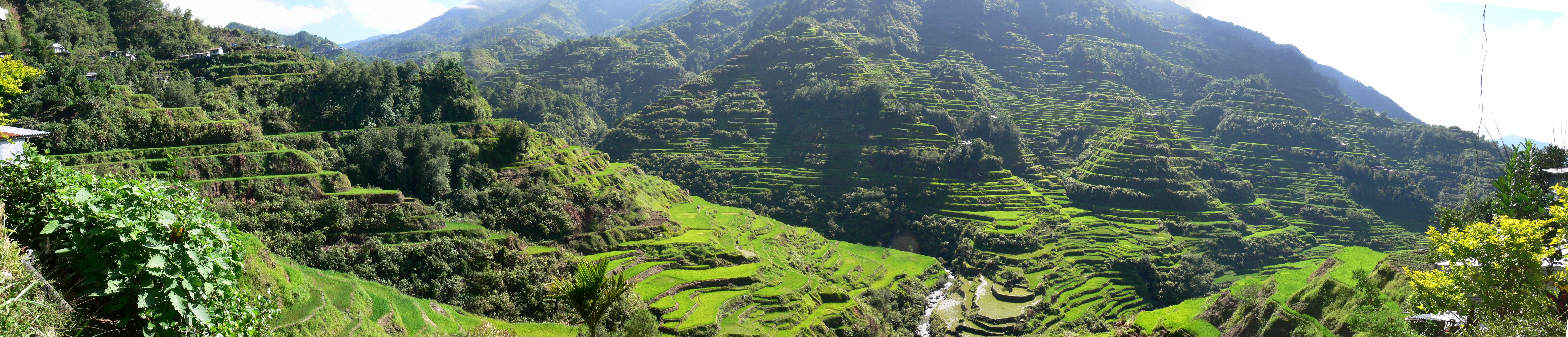
The Banaue Rice Terraces

The Banaue Rice Terraces (Filipino: Hagdan-hagdang Palayan ng Banawe) are 2,000-year-old terraces that were carved into the mountains of Ifugao in the Philippines by ancestors of the indigenous people. The Rice Terraces are commonly referred to by Filipinos as the "Eighth Wonder of the World". It is commonly thought that the terraces were built with minimal equipment, largely by hand. The terraces are located approximately 1500 metres (5000 ft) above sea level. They are fed by an ancient irrigation system from the rainforests above the terraces. It is said that if the steps were put end to end, it would encircle half the globe.

Locals to this day still plant rice and vegetables on the terraces, although more and more younger Ifugaos do not find farming appealing, often opting for the more lucrative hospitality industry generated by the terraces[citation needed]. The result is the gradual erosion of the characteristic "steps", which need constant reconstruction and care. In 2010, a further problem was drought, with the terraces drying up completely in March of that year

Boracay Island Philippines

Boracay is a small island in the Philippines located approximately 315 km (196 mi) south of Manila and 2 km off the northwest tip of Panay Island in the Western Visayas region of the Philippines. Boracay Island and its beaches have received awards from numerous travel publications and agencies. The island comprises the barangays of Manoc-Manoc, Balabag, and Yapak in the municipality of Malay, in Aklan Province. The island is administered by the Philippine Tourism Authority and the provincial government of Aklan. Apart from its white sand beaches, Boracay is also famous for being one of the world's top destinations for relaxation. It is also emerging among the top destinations for tranquility and nightlife.

oracay was originally home to the Ati tribe. Boracay Island was already an inhabited place before the Spaniards came to the Philippines. It was known to the Iberian conquerors as Buracay. At the time of contact with the Europeans, Buracay had a population of one hundred people, who cultivated rice on the island and augmented their income by raising goats.

Sagada, Mt. Province - Hanging Coffins

Photo by: Aldrin J. Garces
While numerous societies cover their dead outside of anyone's ability to see underneath a memorial gravestone or a plaque, a few social orders in China, Indonesia and the Philippines have been hanging their precursors conspicuously on bluff appearances for a considerable length of time. Sagada in the Mountain Province of the Philippines is one area where the act of hanging coffins proceeds right up 'til the present time.


Baguio's Lion Head - LIBERTY, INTELLIGENCE, OUR NATION’S SAFETY


The origin of Baguio’s lion head is as colorful as the history of the road where it currently stands. When the Americans conquered the Cordillera highland in the 1900s, they had a hard time reaching the Benguet mountains. Establishing a short route to these mountains would greatly boost the local economy, so the American  government soon launched an expensive road project, much to the dismay of politicians in Washington D.C.

The Benguet Road (Kennon Road’s original name) was the most expensive engineering work at that time; it had cost the government a  total of $2.7 million, considered excessive for that period.


Despite the controversies, the project pushed through. The American government commissioned Maj. Lyman W. Kennon to complete the  construction in 1905. Later, then Governor General Leonard Wood issued an executive order naming the road after Kennon.


Philippines From The Sky

Places: Laoag, White Beach - Puerto Galera, General Luna - Siargao Island, El Nido, Coron